

Feeding damages to aquatic plants
These require differential diagnosis of leaf damage caused by trace element deficiency.
Damage is most often caused by hungry Loricariids (such as the Ancistrus, Panaque and Peckoltia species) and snails (Pomacea bridgesi is the only apple snail that does not eat plants, although it probably does eat rotting leaves).
Typically, not all plants, but only certain types are affected. Frequently, plants with flat leaves are often the victims, being gnawed by the catfish, causing surface damage. The popular Echinodorus species are a favourite target, although the red varieties are often spared, as they likely contain a bitter substance that serves as a defence mechanism.
Cryptocoryne are rarely affected as are plants that are too small or too soft for catfish.
Loaches, particularly clown loaches, are able to produce such a strong suction with their mouth that they can punch holes with sharp edges in the leaves with a cracking sound. This may be done out of sheer devilment or boredom or might be done to catch snails hiding on the underside of the leaf.
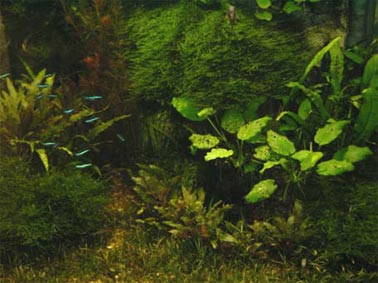
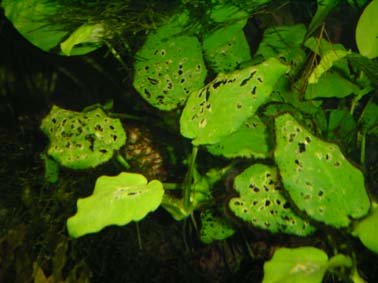
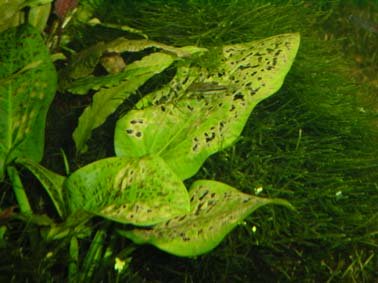
For example, some pictures from a tank belonging to B.K. in Herbertingen/Germany:
Here, Anubias barteri var. nana has been attacked, although Anubias are less often affected than the favourite Echinodorus due to their extremely tough leaves.
Pool data
- 420 l
- CH 5 °dH
- pH 6,5
- CO2 fertilizing
- 150 Watt HQI
- 10 ml Ferrdrakon / day